Build online stores with product catalogs, payments, and shipping.
10 Tools Reviewed
Expert Curated
Regularly Updated
#1 Best Overall
NFTify
Create your own NFT store and marketplace without coding
Freemium
NFTify is a no-code platform for building branded NFT storefronts and marketplaces. It allows creators, artists, and businesses to mint, list, and sell NFTs through their own white-label store without blockchain development skills.
Pros
No-code approach removes the need for blockchain development expertise
White-label storefronts give users their own branded NFT marketplace
Referral system available for growing user base organically
Cons
Very limited information available on the public-facing website pages
NFT market has significantly contracted since 2022, reducing potential buyer audience
Feature set and pricing details are not transparent before account creation
Best for:Creators and brands wanting their own branded NFT store without coding
Ecommerce shopping cart and online store with no transaction fees
Freemium
Free Tier
Ecwid is an e-commerce platform that lets users create online stores and embed shopping carts into existing websites. It differentiates itself by charging no transaction fees and allowing multi-channel selling from a single control panel. The platform is aimed at small and medium businesses looking to sell online without complex setup.
Pros
No transaction fees on any plan, including the free tier
Can be embedded into existing websites without full site migration
Free plan available to start selling immediately
Cons
Limited information available about advanced features and higher-tier plans
May lack the depth of features compared to dedicated platforms like Shopify for larger stores
Ecosystem of apps and integrations is smaller than major competitors
Best for:Small businesses adding e-commerce to an existing website
Add a shopping cart to any website in minutes with simple HTML/JS
Paid
Snipcart is an embeddable e-commerce solution that lets developers add a shopping cart and checkout to any website using HTML attributes and a JavaScript snippet. It supports physical and digital products, multiple payment gateways, shipping carriers, tax automation, and inventory management. It's designed for web developers who want commerce capabilities without migrating to a full e-commerce platform.
Pros
Works with any tech stack, CMS, or static site generator—no platform lock-in
Checkout stays on your site with no redirects, preserving brand experience and conversion
Full CSS customization and extensive API/webhooks for deep integration
Cons
Requires HTML and CSS knowledge—not suitable for non-technical users
2% transaction fee on top of payment gateway fees can add up for high-volume stores
$20/month minimum charge applies once you go live, regardless of sales volume
Best for:Web developers adding e-commerce to existing sites without platform migration
The all-in-one commerce platform for selling online and in person
From $39/mo
Shopify is a comprehensive commerce platform used by millions of merchants to sell products online, in person, and across multiple channels. It provides store building tools, payment processing, shipping management, inventory tracking, marketing features, and analytics in a single centralized admin. The platform scales from solo entrepreneurs to enterprise brands, with plans ranging from $14/month to $2,300/month for high-volume businesses.
Pros
Checkout converts 15% higher on average than competing commerce platforms
Massive app ecosystem with 13,000+ third-party integrations for specialized needs
Scales from a $14/month solo plan to enterprise-level with B2B and wholesale support
Cons
Transaction fees for third-party payment providers add 0.6%-2% on top of card processing rates
Plus plan at $2,300/month is expensive and requires a 1- or 3-year commitment
Full checkout customization is only available on the most expensive Plus plan
Best for:Businesses of any size needing a complete online and in-person selling platform
Create a professional website with AI-powered drag-and-drop building
Freemium
Free Tier
Wix is a website creation platform that lets users build sites through AI-driven generation or manual drag-and-drop editing with 2000+ templates. It includes built-in business tools for eCommerce, bookings, events, and marketing, serving over 260 million users worldwide. The platform also offers developer tools including headless APIs, JavaScript development, and an app marketplace.
Pros
AI site generator creates complete websites from text descriptions in minutes
Pixel-level drag-and-drop editing with no grid constraints offers maximum design freedom
Comprehensive built-in business suite covers eCommerce, bookings, scheduling, CRM, and marketing
Cons
Free tier includes Wix branding on the published site
Sites built on Wix cannot be exported or migrated to another hosting platform
Advanced features and developer tools may require Wix Studio, a separate platform
Best for:Small business owners and creators needing a full website with built-in business tools
Build professional websites, online stores, and grow your business — all in one platform.
Paid
Squarespace is a website building and e-commerce platform that lets users create professional sites using templates or an AI-powered builder, manage online stores, accept payments, book appointments, and run email campaigns. It targets entrepreneurs, freelancers, small businesses, and creatives who need an integrated solution for web presence and online commerce without technical expertise.
Build a professional website with AI — no coding required
Freemium
Free Tier
Webnode is a website builder that uses AI to generate a draft website from a brief description, which users can then customize with a visual editor. It targets small business owners, freelancers, and hobbyists who need a professional web presence without coding knowledge. The platform includes e-commerce, booking, invoicing, multilingual support, and SEO tools.
Pros
AI generates a complete website draft from a text description, with 82% of sites launching on day one
Free tier with unlimited pages and no ads on the website
Built-in business tools including booking, invoicing, and multilingual support in 24 languages
Cons
Free plan includes Webnode branding and uses a Webnode subdomain rather than a custom domain
Pricing details for premium plans are not clearly displayed, making cost comparison difficult
Booking system relies on third-party SimplyBook.me integration rather than a native solution
Best for:Small business owners who need a professional website quickly without technical skills
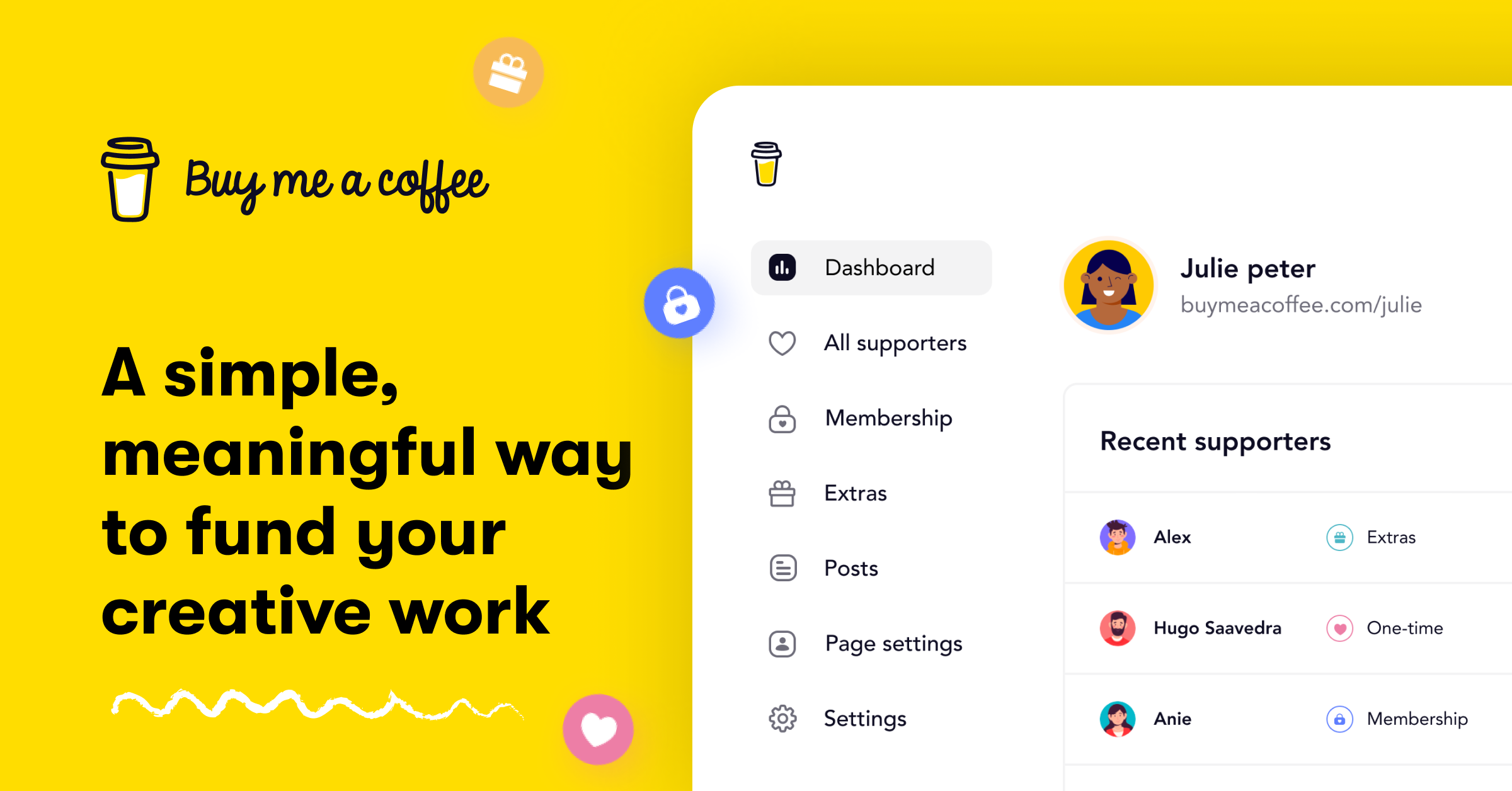
Give your audience an easy way to say thanks with one-time and recurring support.
Freemium
Free Tier
Buy Me a Coffee is a monetization platform for creators that facilitates one-time tips, recurring memberships, and digital product sales. It combines payment processing, content publishing, and email marketing into a single creator-focused tool, offering instant payouts and privacy protection without requiring a traditional e-commerce setup.
Pros
Combines tips, memberships, digital shop, and email marketing in one platform — no need for separate tools
Instant payouts to bank accounts instead of the typical 30-day waiting period
Full ownership of supporter data with export capability; platform never emails your supporters
Cons
Platform takes a percentage cut from every transaction, which adds up for high-volume creators
Limited e-commerce features compared to dedicated platforms like Shopify for physical goods
No advanced analytics or business intelligence tools mentioned for tracking supporter behavior
Best for:Independent creators wanting a simple way to accept fan support and sell digital products.
WordPress website builder with drag-and-drop editing and AI tools
Paid
Elementor is a WordPress website builder used on over 21 million websites, representing roughly 13% of all sites worldwide. It provides a visual drag-and-drop editor, theme builder, dynamic content, WooCommerce integration, and AI-powered content generation tools. The platform targets individual creators, web agencies, and enterprises with tiered plans ranging from basic website editing to full-featured hosting, optimization, and AI capabilities.
Pros
Massive ecosystem with 21M+ websites built, ensuring strong community support and third-party resources
Pixel-perfect drag-and-drop editor with CSS transforms, masks, motion effects, and global styles
Comprehensive all-in-one platform covering hosting, domains, email deliverability, and AI content generation
Cons
AI features and optimization tools are only available in the top-tier Elementor One plan
Essential plan lacks popup builder, custom CSS, and eCommerce features, limiting basic-tier usefulness
Locked into WordPress ecosystem — not suitable for non-WordPress projects
Best for:WordPress users and agencies wanting visual, code-free site design with pro features
Sell digital products and earn your first dollar online
Freemium
Free Tier
Gumroad is an e-commerce platform that lets creators sell digital products, subscriptions, and memberships with no upfront costs. It charges a 10% flat fee per transaction plus $0.50 per sale. It is primarily used by independent creators, artists, and educators selling digital goods like courses, design assets, ebooks, and software.
Pros
No monthly fees or upfront costs — you only pay when you make a sale
Extremely simple setup: upload a file, set a price, and start selling immediately
Supports diverse payment models including subscriptions, one-time, and pay-what-you-want
Cons
10% transaction fee is significantly higher than competitors like Shopify or Payhip at scale
Limited storefront customization compared to dedicated website builders
No phone or live chat support — primarily self-serve help center
Best for:Independent creators selling digital products like courses, ebooks, and design assets